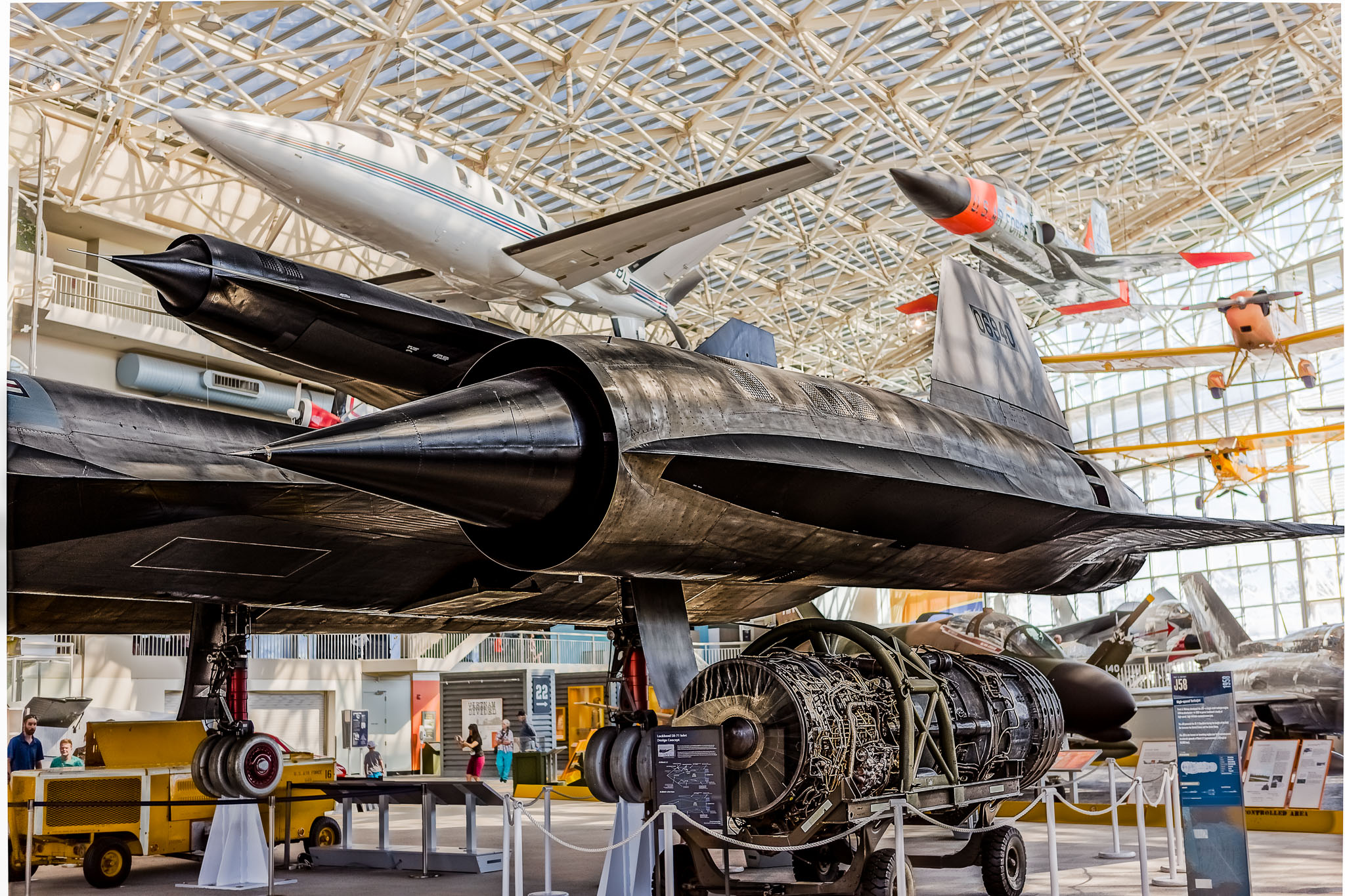
Lockheed M-21 Blackbird — the world's fastest airplane
The Blackbird family of aircraft cruise at speeds of more than Mach 3 and fly over 85,000 feet (25,500 m) in altitude. Conceived nearly 50 years ago, Blackbirds remain the fastest and highest flying air-breathing production aircraft ever built.
This M-21 is a unique variant of the A-12, the earliest Blackbird type. Built for a CIA program code-named "Tagboard," the M-21 carried unpiloted vehicles for intelligence gathering. These drones were intended for launch from the M-21 "mother ship" for flights over hostile territories. Design features of the M-21 include the second seat for the Launch Control Officer and the launch pylon on which the drone is mounted.
The Museum's M-21 was built in 1963, and is the sole surviving example of its type.
(mounted on top) Lockheed D-21B Drone
The D-21 drone was an unpiloted aircraft originally designed for CIA and Air Force surveillance missions over particularly hostile territories. Launched from airborne carrier aircraft, the D-21's Marquardt RJ43-MA-11 ramjet engine propelled it at speeds over 2,000 mph. (3,200 km/h). The two Lockheed M-21 Blackbird "mother ships" were designated M/D-21s when the D-21 "daughter" drone was mounted on top.
The D-21's Mission
During a reconnaissance mission, the D-21 drone would follow a pre-programmed flight path over areas of interest. Then the drone would return to international airspace, where the reconnaissance film package, equipped with its own parachute, was ejected. The package was then recovered in mid-air by a specially equipped airplane or at sea by a ship. Shortly after the film package was jettisoned, the drone self-destructed.
Runaway
Engineer Ben Rich worked on the D-21 program starting in 1962. Later, when he succeeded Clarence "Kelly" Johnson as the head of Lockheed's secret Skunk Works, he told of a day in the mid-1980s when a CIA man arrived carrying a panel. "Do you recognize this?" Rich did, but he couldn't figure out how the CIA man had gotten it. "It was a Christmas gift from a Soviet KGB agent," the CIA man explained. "He told me it was found by a shepherd in Siberia." The panel was part of a D-21 drone that had disappeared during testing over China in 1969. Hopelessly off course, the D-21 ran out of fuel and crashed in the vast Siberian wilderness.