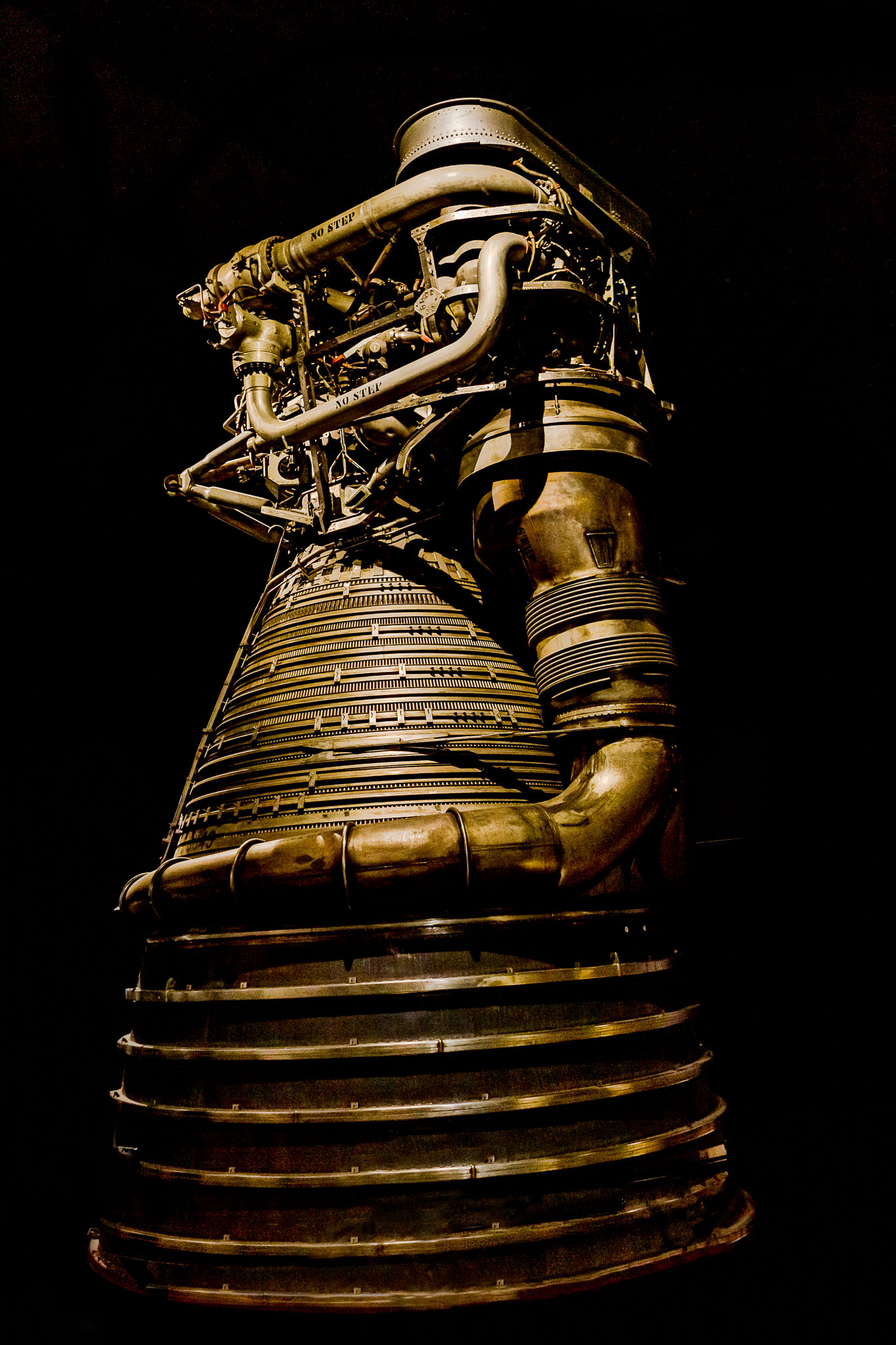
Used for the Apollo space program's Saturn 5 rocket, the F-1 engine is the most powerful single-nozzle liquid-fueled rocket engine ever flown. The M-1 rocket engine was designed to have more thrust, but it was only tested at the component level. Also, the RD-170 produces more thrust, but has four nozzles. The F-1 burned RP-1 (rocket grade kerosene) as the fuel and used liquid oxygen (LOX) as the oxidizer. A turbopump was used to inject fuel and oxygen into the combustion chamber.
The heart of the engine was the thrust chamber, which mixed and burned the fuel and oxidizer to produce thrust. A domed chamber at the top of the engine served as a manifold supplying liquid oxygen to the injectors, and also served as a mount for the gimbal bearing which transmitted the thrust to the body of the rocket. Below this dome were the injectors, which directed fuel and oxidizer into the thrust chamber in a way designed to promote mixing and combustion. Fuel was supplied to the injectors from a separate manifold; some of the fuel first traveled in 178 tubes down the length of the thrust chamber — which formed approximately the upper half of the exhaust nozzle — and back in order to cool the nozzle.
A gas generator was used to drive a turbine which drove separate fuel and oxygen pumps, each feeding the thrust chamber assembly. The turbine was driven at 5,500 RPM, producing 55,000 brake horsepower (41 MW). The fuel pump delivered 15,471 US gallons (58,560 litres) of RP-1 per minute while the oxidizer pump delivered 24,811 US gal (93,920 l) of liquid oxygen per minute.
Environmentally, the turbopump was required to withstand temperatures ranging from input gas at 1,500 °F (820 °C) to liquid oxygen at −300 °F (−184 °C). Structurally, fuel was used to lubricate and cool the turbine bearings.
Test firing of an F-1 engine at Edwards Air Force Base
Below the thrust chamber was the nozzle extension, roughly half the length of the engine. This extension increased the expansion ratio of the engine from 10:1 to 16:1. The exhaust from the turbopump was fed into the nozzle extension by a large, tapered manifold; this relatively cool gas formed a film which protected the nozzle extension from the hot (5,800 °F (3,200 °C)) exhaust gas.
Each second, a single F-1 burned 5,683 pounds (2,578 kg) of oxidizer and fuel: 3,945 lb (1,789 kg) of liquid oxygen and 1,738 lb (788 kg) of RP-1, generating 1,500,000 lbf (6.7 MN; 680 tf) of thrust. This equated to a flow rate of 671.4 US gal (2,542 l) per second; 413.5 US gal (1,565 l) of LOX and 257.9 US gal (976 l) of RP-1. During their two and a half minutes of operation, the five F-1s propelled the Saturn V vehicle to a height of 42 miles (222,000 ft; 68 km) and a speed of 6,164 mph (9,920 km/h). The combined flow rate of the five F-1s in the Saturn V was 3,357 US gal (12,710 l)[4] or 28,415 lb (12,890 kg) per second. Each F-1 engine had more thrust than three Space Shuttle Main Engines combined.